What Is Georgia's 299c Property Tax Freeze? (O.C.G.A. § 48-5-299(c))
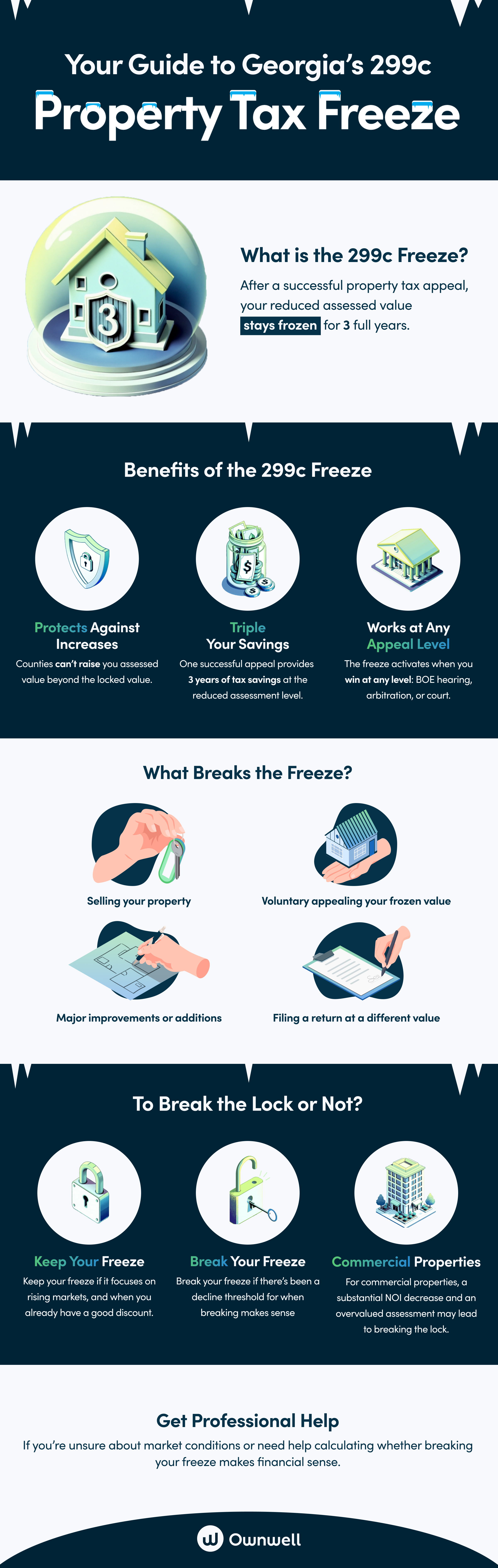
Georgia's 299c freeze — formally O.C.G.A. § 48-5-299(c) — locks a property's assessed value for three years following a successful property tax appeal, preventing the county tax assessor from increasing that value during the freeze period.
Key Takeaways
Three-year protection: Locks your property's assessed value for the appeal year plus the two following tax years.
Trigger: The freeze only activates after a successful appeal resulting in a value reduction at the BOE, hearing officer, arbitrator, or Superior Court level.
What's frozen vs. what isn't: Only the assessed value is frozen. Millage rates are set annually and can still change your tax bill.
Four ways to break it: The freeze can be voided by property sale, substantial improvements, voluntarily filing a new appeal, or filing a tax return at a different valuation.
Strategic re-appeal: If market values drop significantly below your frozen value, breaking the freeze to re-appeal may generate greater savings.
How Much Are You Over Paying?
Scope of the Freeze and Example Calculation
Important: The 299c freeze locks only your property's assessed value. Your millage rate is set annually by local governments and is never frozen.
Georgia law states that a property’s assessed value is 40% of its fair market value. Below is an example of how the freeze works:
Property’s Initial Pre-Appeal Value:
Fair market value: $500,000
Assessed value (40%): $200,000
2025 Successful Appeal:
New fair market value: $480,000 (after $20,000 reduction)
New assessed value: $192,000
Tax Calculation (Hypothetical 30 Mill Rate):
2025, 2026, and 2027 property taxes: $192,000 × 0.030 = $5,760
Note: While the $192,000 is locked, the $5,760 bill could change if the 30 mill rate fluctuates.
How to Obtain the 299c Freeze in Georgia
The freeze is not automatic. To activate it, you must:
File a timely appeal: Within 45 days of receiving your assessment notice.
Proceed to formal resolution: Reach a written settlement or obtain a Board of Equalization (BOE) decision.
Attend your hearing: Present evidence supporting your valuation.
Ensure documentation: Confirm the 299c freeze language is explicitly included in the final written decision or settlement.
Exceptions That Can Break the Freeze
The 299c freeze can be invalidated by:
Substantial Additions or Improvements: Significant physical changes that materially increase the property's value.
Selling the Property: The freeze terminates automatically upon transfer of ownership.
Voluntarily Appealing a Locked Value: If you appeal again, you "break the lock." This is only recommended if market values have crashed.
Filing a Return at a Different Valuation: Reporting a different value on a tax return during the freeze period can void the protection.
Illustrative Scenario: Appealing a Frozen Commercial Value
Commercial property appeals typically involve more sophisticated valuation methodologies, including income capitalization approaches and detailed market analyses. However, the fundamental process for securing the 299c freeze remains the same.
Example: Commercial property with an initial frozen FMV of $2,500,000 (25 mill rate)
Scenario | Declining Market Value | Frozen Assessed Value (40%) | New Assessed Value | Annual Tax Savings |
Current Freeze | $2,500,000 | $1,000,000 | $1,000,000 | $0 |
5% Decline | $2,375,000 | $1,000,000 | $950,000 | $1,250 |
10% Decline | $2,250,000 | $1,000,000 | $900,000 | $2,500 |
20% Decline | $2,000,000 | $1,000,000 | $800,000 | $5,000 |
Should You Forgo Your 299c Freeze and Reappeal?
Determining whether to relinquish a 299c property tax freeze and risk reappealing hinges on carefully analyzing current market values versus the frozen assessment to maximize potential tax savings.
The Core Dilemma: Weighing Stability vs. Potential Savings
The 299c freeze provides valuable predictability and protection against rising assessed values, especially in dynamic markets, by locking in an assessed value for three years.
However, if market values decline significantly below the current frozen assessed value, maintaining the freeze means paying taxes on an inflated valuation.
When to Maintain Your 299c Freeze
Keep your frozen assessed value if:
Property values are rising: In an appreciating market, your frozen assessment becomes increasingly valuable
Your freeze discount is substantial: If your frozen value is ~20% or more below current market assessments
You plan to hold the property: Long-term owners benefit most from the freeze
Market indicators suggest continued growth: Current real estate market forecasts show continued appreciation and growth
When to Consider Giving Up Your Freeze
The core principle is to appeal if a property's current fair market value is demonstrably lower than the fair market value equivalent of its frozen assessed value.
So, consider appealing again (and potentially losing your freeze) if:
Significant market downturn: Your property's actual value has dropped substantially below your frozen assessment
The math supports it: Calculate the potential savings:
Current frozen assessed value × 40% × millage rate = Current tax bill
Potential new assessed value × 40% × millage rate = Potential tax bill
If the difference exceeds the risk of future increases, consider appealing
In general, there’s no single, fixed percentage for a "tipping point" that universally applies, as the decision to appeal depends on the property’s:
Specific frozen value
The current market value
The applicable millage rate
Using a Professional Service
To secure the most considerable property tax reduction for the upcoming three years, consider leveraging a professional property tax appeal service such as Ownwell. We can assist in building the strongest possible appeal case.
Our local property tax consultants are well-versed in each county’s intricacies and are familiar with the appraisers, boards, and hearing officers.
Our local expertise and proprietary software generate an average annual savings of $774 in savings per homeowner. So, ensure you maximize your savings potential with Ownwell's expert guidance. See how much you can reduce your assessed value and freeze it for the next three years!
Want to Try What Made Ownwell Famous?
Frequently Asked Questions
How long does the freeze last?
Three tax years: the year of the successful appeal plus the two following years.
Does it apply to commercial properties?
Yes, the 299c freeze applies to both residential and commercial properties in Georgia.
Is the millage rate frozen?
No. Only the assessed value is locked. Local governments can still change millage rates annually.